

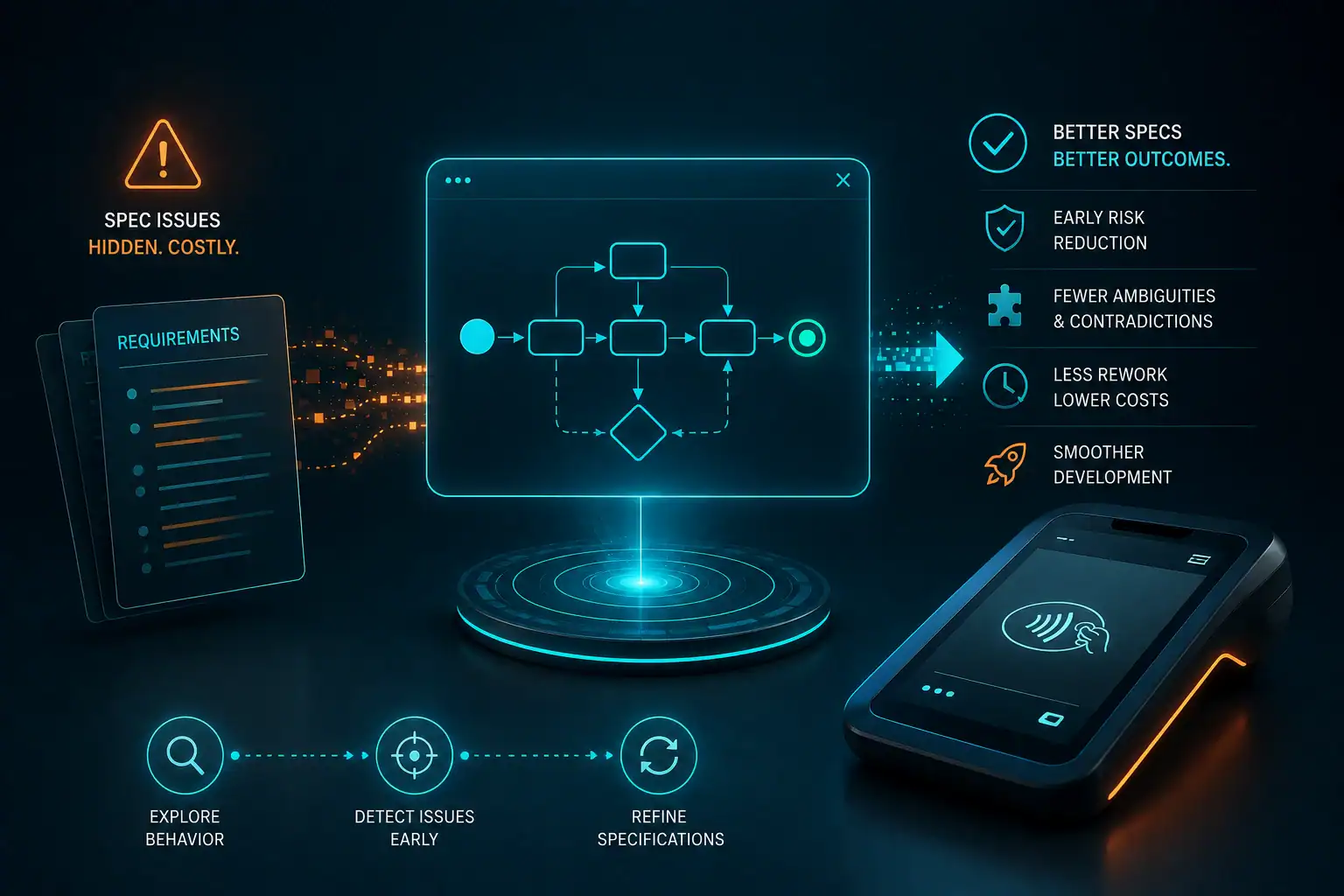
Many engineering issues uncovered during development do not originate in the implementation itself. They begin much earlier—in the specifications that define how a system is expected to behave.
In complex projects, these specifications may include functional and behavioral requirements, protocol and interface definitions, system requirements, or industry standards. Individually, they often appear coherent. But once combined into complete operational flows, hidden conflicts can emerge: contradictory rules, ambiguous behaviors, missing transitions, or incomplete command handling.
These weaknesses frequently remain invisible until implementation begins—or even later during integration.
A simulation-first approach offers another path: explore the system’s expected behavior before any code is written, allowing specification issues to surface while they are still inexpensive to resolve.
What is simulation-first validation?
Simulation-first validation consists of transforming specifications into an executable behavioral model before a complete implementation exists.
Rather than relying solely on static documentation, engineering teams explicitly describe elements such as:
- commands and expected responses
- system states and transitions
- interaction sequences
- preconditions and outcomes
- protocol or interface rules
- error and exception paths
The model can then be exercised through different sequences and operating conditions to verify that the specified system logic is complete, coherent, and internally consistent.
This approach does not replace implementation testing or system validation. Instead, it addresses an earlier question: Are we building the right system from a consistent specification?
Making hidden contradictions visible
Specifications are typically reviewed document by document, while real systems operate through combinations of states, commands, conditions, and interactions. This difference is where many specification issues originate.
Consider a simplified example. One requirement defines a command as valid in a particular state. Another requirement, located elsewhere, specifies transition rules that make reaching that state impossible under the same conditions.
Neither requirement appears incorrect in isolation.
Together, however, they describe a system that cannot behave as intended.
Constructing the behavioral model forces engineers to make every relationship explicit: current state, triggering condition, expected response, and resulting transition. This process quickly reveals problems such as:
- contradictory requirements
- unreachable states
- missing transitions
- incomplete command handling
- ambiguous expected responses
- incompatible rules across specifications
Instead of discovering these inconsistencies during implementation, teams can resolve them while refining the specifications themselves.
Creating a continuous specification feedback loop
Whenever the simulation exposes an inconsistency, the corresponding requirement can be reviewed, clarified, and incorporated into an updated version of the model.
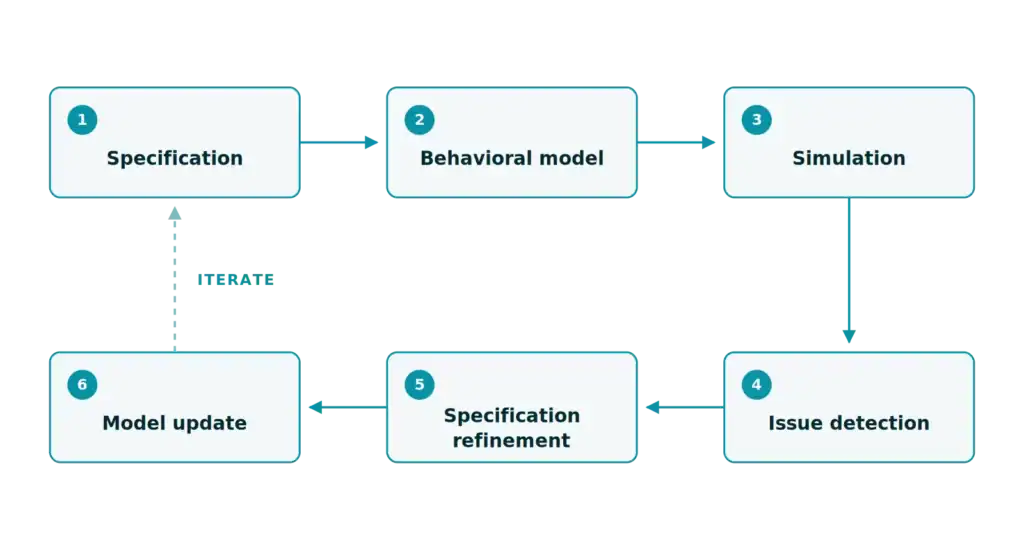
Rather than being a one-time activity, modeling becomes an iterative engineering practice that continuously improves specification quality before development progresses.
The objective is not to validate a system before it exists. It is to strengthen the quality of the specifications developers will rely on throughout implementation.
Reducing downstream rework
Once implementation starts, specification defects become significantly more expensive to correct.
Different teams may interpret the same requirement differently. Components may be developed around incompatible assumptions. Fixing the resulting issues often requires software modifications, interface revisions, updated test cases, and additional integration effort.
By challenging behavioral logic at the specification stage, simulation-first validation helps reduce:
- rework caused by unclear or conflicting requirements
- divergent interpretations across engineering teams
- implementation of incomplete functional flows
- integration issues rooted in specification defects
This is particularly valuable for transactional applications and embedded systems, where complex interactions between commands, responses, states, and protocols make hidden inconsistencies especially difficult to identify through document reviews alone.
From specification model to Model-Based Testing
Once the specifications have been clarified and stabilized, the behavioral model continues to deliver value throughout the development lifecycle.
Within a Model-Based Testing (MBT) workflow, the same model becomes the reference used to derive and maintain validation scenarios as requirements evolve. Rather than manually updating large collections of test cases, engineering teams can keep testing aligned with changing specifications through a shared behavioral representation.
The model therefore evolves from a specification review tool into a long-term engineering asset that supports consistency across both development and validation activities.
For complex systems, this raises an important question: How many implementation issues could be avoided simply by challenging the specifications before development begins?
How Mellonne applies this approach
At Mellonne, Model-Based Testing is at the heart of how we approach complex validation challenges for transactional applications and embedded systems. By transforming functional, behavioral, protocol, and standards-based specifications into executable behavioral models, we help engineering teams detect specification issues earlier, improve alignment across stakeholders, and build more robust validation workflows from the very beginning.
Want to explore how Model-Based Testing could strengthen your development and validation process?
Contact Mellonne to discuss your project and testing challenges.



Stay informed
Receive occasional product updates, certification insights and security news from Mellonne.